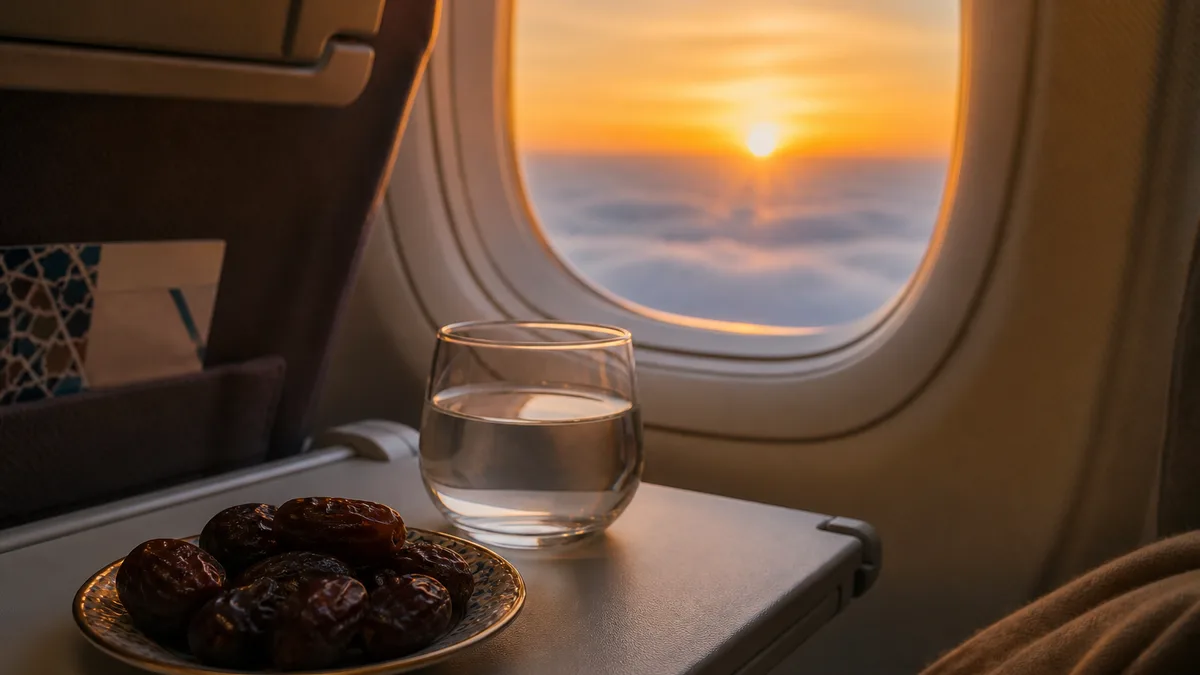
Iftar at 38,000 feet: whose sunset counts?
The widely followed position is elegantly simple: a fasting traveller breaks fast when the sun sets where they actually are — and at altitude, that means the sunset you observe from the aircraft, not the one printed for the city below, and certainly not your departure city's timetable. Altitude delays sunset noticeably: from a cruising jet the sun stays visible minutes after it has set on the ground beneath you. If you can see the sun above the horizon from your window, the day has not ended.
Direction of travel rewrites your day's length. Fly west and you chase the sun — a London to New York departure in the afternoon can stretch a fast hours longer as sunset keeps retreating ahead of you. Fly east and the day collapses — sunset rushes toward you, and a fast can end far earlier than it would have at home. Neither is a problem to solve; both are simply worth knowing before you choose a departure time, because the difference between a 14-hour and an 18-hour fast is a booking decision.
The traveller's exemption — and choosing whether to use it
Islamic law explicitly anticipates this situation: travellers are granted an exemption from fasting, with missed days made up after the journey. This is not a loophole but a stated concession in the Qur'an, and scholars across schools recognise it — the conditions and distances at which it applies vary by school, which is why the honest guidance is to consult a scholar you trust rather than a travel website. What a travel website can tell you: plenty of travellers fast anyway on short flights and take the exemption on gruelling westbound long-hauls, and both are established practice.
If you do fast, build the flight around it rather than the other way round. Overnight eastbound departures often mean sleeping through most of the fasting window; morning westbound long-hauls maximise awake fasting hours in a dry cabin. Cabin air is exceptionally dry — hydrate seriously between iftar and suhoor on either side of the flight, and treat caffeine tapering in the days before travel as part of the plan, not an afterthought.
What airlines will actually do — and what they won't
Set expectations by carrier type. Gulf and Muslim-majority airlines run genuine Ramadan operations: dates and water distributed at sunset, iftar boxes on relevant sectors, crews announcing timing, schedules on some routes adjusted around iftar. On most European and North American carriers, expect none of that by default — Ramadan is not in the service design, and the crew's awareness will vary from warm accommodation to blank looks. That is not hostility; it is a service spec you route around.
Two requests do most of the work. First, order the Muslim meal — code MOML — when you book, not on the day; it guarantees halal-prepared food is aboard for you (our airline halal meal guide covers how each major carrier handles it). Second, tell crew early in the flight that you are fasting and would like your meal held to a specific time — framed as a timing request, it is almost always accommodated. Carrying your own dates and a bottle filled after security means sunset never depends on a trolley's position.
Timing tools: knowing when sunset reaches your seat
You need two pieces of information in the air: where you are, and when the sun sets there. The seat-back moving map gives position crudely; a live flight tracker gives it precisely — our global tracker plots your aircraft in real time from open transponder data, and works on any phone browser before departure and after landing for the legs of the journey where timing also matters. For the airborne hours, prayer apps with in-flight or travel modes estimate prayer windows along a moving route.
The window seat is the analogue instrument that never fails: on a clear evening, watching the sun touch the horizon from altitude is both the most reliable iftar signal available and one of the quiet privileges of flying during Ramadan. If you are seated over the wing or on the wrong side for the sun, ask a window-side neighbour — the question has started more good conversations than it has ever caused problems.
Arrivals, jet lag, and keeping the routine on the ground
The flight is one day of Ramadan; the arrival is the rest of the trip. Landing westbound means your body clock runs hours ahead of local time — suhoor comes brutally early by body time for the first days, so front-load sleep and treat the first fast at destination gently. Landing eastbound compresses the day: shorter fasts, but suhoor arrives before your body believes it is night. Either way, anchoring immediately to local prayer times is both the religious requirement and, usefully, the fastest jet-lag cure aviation medicine knows.
Plan the first iftar before you fly: know where it is coming from — hotel restaurant, a halal neighbourhood near your accommodation, or supermarket dates and water in your day bag. Our halal dining guides and halal travel hub cover the destinations UK travellers fly most, and airport arrivals are increasingly well served: several major hubs run iftar distributions in Ramadan, and our airport prayer room guide maps the quiet places to pray between flights.