The rule in one paragraph
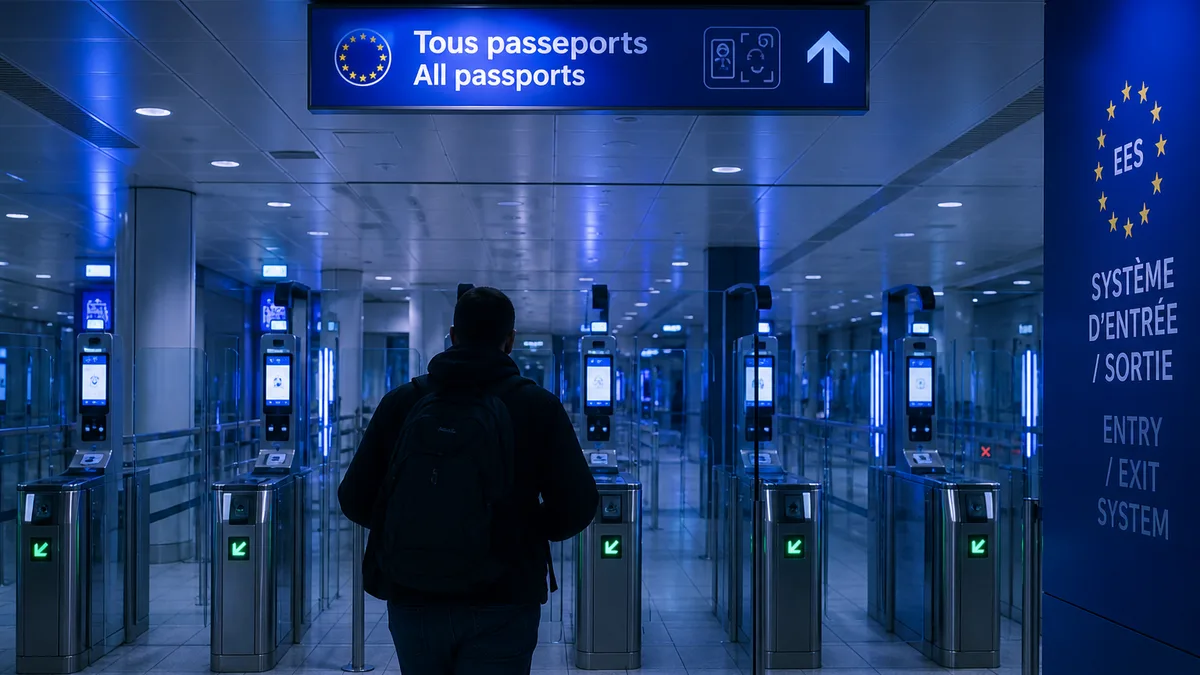
EES is a border process, not a form you fill in at home. When you arrive in (or leave) the Schengen area as a short-stay UK visitor, border staff register or verify your biometrics and log the crossing electronically. The EU’s phased rollout ended on 9 April 2026; since 10 April 2026 EES has been fully operational at every external border crossing point, passports are no longer stamped, and the system’s calculator tracks the 90-days-in-180 limit.
On your first crossing since EES started, an officer or self-service kiosk records a facial image, four fingerprints and your passport details; the EU says children under 12 are not fingerprinted. On later trips the system only checks your face or fingerprints against that record, which is quicker. GOV.UK says you do not need to do anything before you reach the border and there is no charge. The EU keeps each entry and exit record for three years.
Your passport still has to meet Schengen validity rules: issued within the last ten years, and valid for at least three months after the day you plan to leave the Schengen area. EES does not replace GHIC, travel insurance, or the forthcoming ETIAS authorisation.
Some UK nationals are exempt — notably those living in an EU country under the Withdrawal Agreement who hold a qualifying residence document. They should show that document to the border guard instead of registering. The EU’s “To whom does the EES not apply?” page lists every exemption; re-read it before you travel on a non-standard document.
Where your EES check happens
Flying, or sailing from a UK port other than Dover: you register on arrival at the first Schengen airport or port.
Eurostar from St Pancras, Eurotunnel Le Shuttle at Folkestone and the Port of Dover: GOV.UK says EES checks are completed at the border before you leave the UK. Eurostar has self-service kiosks in three areas of St Pancras before the ticket gates, Eurotunnel has a dedicated pre-registration area, and Dover processes EES at its Western Docks. Follow your operator’s advice on arrival times.
Cruises: sailings that start and finish outside Schengen (for example, round trips from a UK port) are usually exempt for day trips ashore, though port authorities can still require checks. Joining or leaving a cruise inside Schengen usually means an EES check.
Ireland and Cyprus are EU countries outside the Schengen area and do not use EES.
EES is fully operational; ETIAS is not — keep them separate
EES = biometrics and electronic logging when you physically cross a Schengen external border. Fully operational for UK visitors since 10 April 2026.
ETIAS = a separate online pre-travel authorisation the EU will require later. When we checked the official EU site on 15 November 2026, ETIAS was not in operation, no applications were being collected, and the EU said it will announce the start date several months ahead; the fee will be €20. Any site charging for “ETIAS registration” now is not the official EU portal. Details: ETIAS for UK travellers.
A normal future Spanish or Italian trip will stack three layers: valid passport → ETIAS (once it starts) → EES at the border. Right now, EES is the layer that changes how long it takes to reach your hotel.
Why Spanish leisure arrivals feel slower for Brits
Spain is still the UK’s top outbound country. After Brexit, British passports use third-country lanes rather than EU free-flow. That concentrates UK traffic into EES processing at gateways such as Palma (PMI), Málaga (AGP), Alicante (ALC) and Barcelona (BCN).
Neither GOV.UK nor the EU publishes expected waiting times. GOV.UK’s advice is to be prepared to wait longer than usual, especially at busy times. Your first EES registration takes longest; later crossings only verify your record, and travellers with a chip (biometric) passport can use self-service kiosks where an airport provides them. The buffers below are FlightLogic’s own planning allowances, not official figures — staffing and kiosk availability change week to week.
Two moments matter: arrival (transfer driver, car hire, dinner reservations) and departure (Spanish exit control again before Jet2, easyJet, Ryanair or BA bag drop). Our Palma airport guide and lounge notes cover capacity; this page is about the queue in front of both.
A buffer checklist that actually works
• On peak UK bank-holiday weeks into Spanish leisure airports, assume the long end of wait ranges before you promise anyone a pick-up time.
• Add roughly 30–45 minutes beyond your old “stamp-and-go” buffer for Schengen exits in July–August.
• Keep families together at the booth or kiosk — splitting adults and children usually slows everyone.
• Travelling by Eurostar, Eurotunnel or ferry from Dover? Your EES check happens in the UK before departure, so follow the operator’s arrival-time advice.
• Use EES self-service kiosks where offered; they need a chip (biometric) passport.
• Dual EU/UK nationals: use the EU passport in free-flow lanes when eligible. Returning to the UK as a British dual national is a different boarding problem — see UK dual-nationality passport rules.
• Only message a hotel transfer once you are fully landside.
Hotels and airlines that match the new timing
Transfer notes on our Spanish hotel guides exist because border time now eats into first-night plans. Start with Spain hotels, Barcelona, Málaga and Madrid, and pick carriers with UK–Spain routing context.
Does a long EES queue unlock UK261 cash?
No — border processing is not airline fault. UK261 can still matter if the airline delay causes a missed connection on one ticket. Duty-of-care meals and hotels follow the operating carrier’s disruption, not the passport queue. See UK261.
Before each trip, reconfirm passport dates, skim the destination airport’s third-country guidance, and ignore third-party “ETIAS pre-registration” offers.