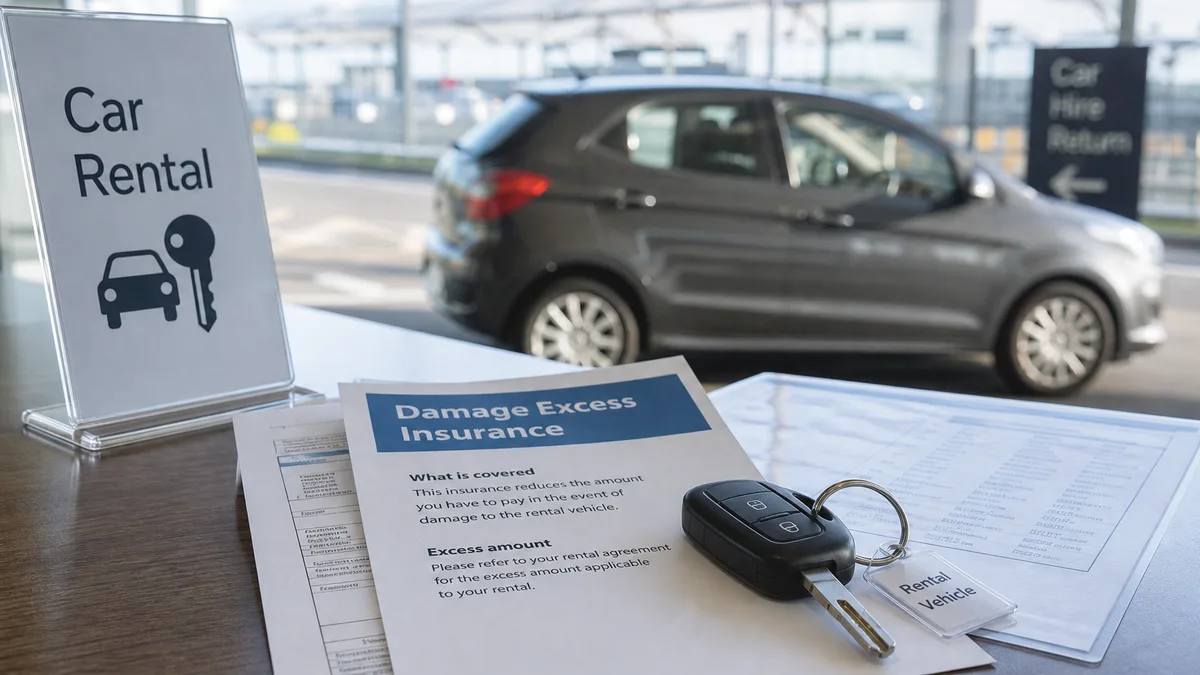
What the excess actually is
A standard hire agreement in the UK and Europe includes collision damage waiver and theft cover by default — but with an excess: the first portion of any damage or theft bill, commonly a four-figure sum, that sits with you. Kerb a wheel, chip the windscreen, or hand the car back with a dent of disputed origin, and the hire company charges your card up to that excess without needing your agreement on the amount first.
Everything sold around car hire protection is really about that one number. The rental desk's "super damage waiver" reduces the excess to zero or near-zero for a daily fee. A standalone excess policy leaves the excess in place but reimburses you when it is charged. Same financial risk, two very different price tags — and the desk product is priced for people deciding under time pressure with a queue behind them.
Desk waiver vs standalone policy: the honest comparison
The standalone policy's advantages are price — daily rates are typically a fraction of desk waiver rates, and annual multi-hire policies make repeated rentals cheaper still — and scope: many standalone policies include tyres, windscreen, roof, undercarriage and misfuelling, which basic desk cover frequently excludes. Its disadvantage is cash flow: the hire company charges you first, and you reclaim from the insurer with paperwork.
The desk waiver's advantage is exactly that cash flow — nothing is charged to you at all — plus a smaller deposit hold with some companies. If you cannot tolerate a four-figure card charge sitting in dispute for a few weeks, the desk product has a real use. For everyone else, buying excess cover before travel and declining it at the desk is the standard money-saving play, and it is entirely your right to decline.
What the desk will say, and what it means
"We don't accept third-party insurance" is the line most renters hear. It is true and changes nothing: standalone excess insurance is a contract between you and your insurer, not the hire company. The hire company charges your card for damage exactly as if you were uninsured; your insurer then reimburses you. You are not asking the desk to accept anything — you are declining their optional product, which the agreement permits.
Expect the deposit hold on a credit card in the lead driver's name regardless of any insurance — that is the hire company's security, not insurance. Two adjacent desk upsells deserve equal scepticism: dynamic currency conversion ("pay in pounds?") — always choose the local currency, because the conversion is priced against you — and fuel options other than full-to-full, which is the only fuel policy where you pay pump price for exactly what you used.
Making a standalone claim actually pay
Standalone claims fail on paperwork, not on principle. At collection, photograph or video the whole car — panels, wheels, glass, roof, interior — with the rental agreement visible, and make the checkout agent record every existing mark. At return, do the same and get a signed return condition report; if the return desk is unstaffed (early flights), photograph the car in its bay with signage visible and keep the drop-box receipt.
If damage is charged, you will need the rental agreement, the damage report and invoice, proof of the card charge, and your booking confirmation. File promptly — policies carry claim windows. Dispute any charge that arrives without an itemised invoice: hire companies must evidence what they charged for, and card providers can assist. Where the hire was paid on a UK credit card, Section 75 of the Consumer Credit Act can add protection on qualifying transactions between £100 and £30,000, and chargeback exists below that.
Who should still buy at the desk
A minority of renters are better served by the desk product: anyone who cannot absorb a large temporary card charge; renters using debit cards where the company's debit-card terms mandate their own cover; very short one-day hires where the standalone policy minimums exceed the waiver; and renters in jurisdictions or with vehicle classes a standalone policy excludes — always read the policy's country and vehicle lists before relying on it.
Everyone else should treat excess cover like airport parking: a product to buy calmly online before travel, not under pressure at a counter. Pair this with our annual-versus-single-trip logic — if you hire cars more than once or twice a year, an annual excess policy usually wins — and check whether your travel insurance already includes an excess benefit before buying anything, because duplicate cover pays only once. For booking the hire itself — rates, fuel policy, photos and desk upsells — use our car hire ultimate guide.