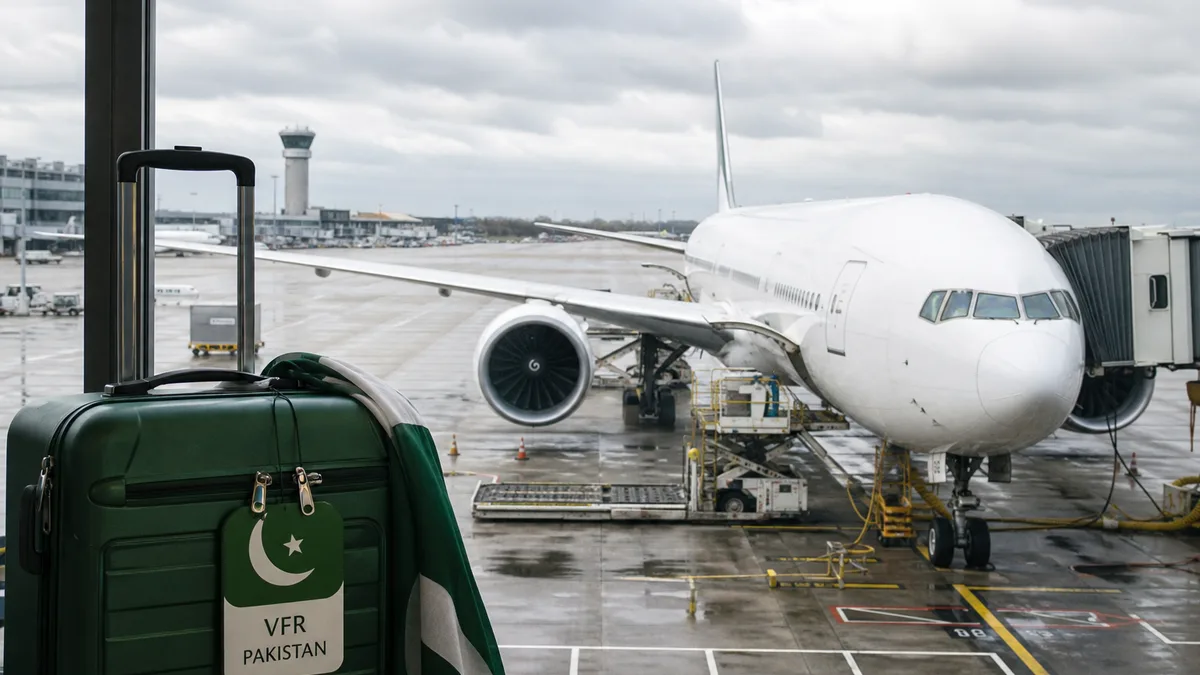
Does PIA fly to the UK right now?
Yes, and the timeline matters because a lot of published guidance is still out of date.
The UK removed Pakistan from its Air Safety List on 16 July 2025. PIA then had to obtain a separate UK operating permit, which came through around September 2025, and the first flight followed on 25 October 2025: Islamabad to Manchester as PK701, on a Boeing 777. London Heathrow resumed on 29 March 2026, with Lahore–Heathrow added the following day.
As of late July 2026 the schedule is nine weekly Pakistan–UK flights:
• London Heathrow (Terminal 4) — Islamabad three times weekly (PK785/786) and Lahore once weekly (PK757/758). Four weekly in total.
• Manchester — Islamabad four times weekly (PK701/702, increased from three on 3 July 2026) and Lahore once weekly (PK709/710, launched 3 July 2026). Five weekly in total.
No route is daily. Birmingham is not currently served — it has been announced repeatedly since 2025 but has not launched, and some aviation outlets have wrongly reported it as reinstated. Check the timetable before assuming a BHX option exists.
Schedules on thin, recently restored routes move around. Confirm frequencies directly with the airline before booking, and see our Manchester Airport guide and Heathrow guide for terminal and transport detail.
Why UK flights stopped in 2020
The suspension followed the crash of PK8303, an Airbus A320, at Karachi on 22 May 2020, in which around 97 people died.
In the aftermath, Pakistan's aviation minister told parliament on 24 June 2020 that 262 of 860 licensed Pakistani pilots held suspicious or fraudulent licences. The European Union Aviation Safety Agency withdrew PIA's Third Country Operator authorisation with effect from 30 June 2020, and the UK Civil Aviation Authority suspended PIA's UK permit at effectively the same moment, from 1 July 2020 — the UK was still bound to follow the EASA decision during the Brexit transition period.
The two regulators only diverged on the way back. EASA reinstated PIA's authorisation on 29 November 2024 and PIA resumed Europe with Islamabad–Paris on 10 January 2025. The UK moved separately and later, delisting Pakistan on 16 July 2025.
The reinstatements followed reforms to Pakistan's licensing and regulatory oversight, reviewed by both EASA and the UK authorities. Readers deserve both halves of that story: the ban was serious and evidence-based, and it was lifted only after independent re-inspection.
A genuinely distinguished history — and one myth worth correcting
PIA was created on 11 March 1955, when the privately owned Orient Airways — registered in 1946 and flying from 1947 — was merged with a new state airline under the PIA Corporation Ordinance.
Its early record is stronger than its recent reputation suggests. PIA wet-leased a Boeing 707 from Pan Am and flew Karachi–London with it from 7 March 1960, plausibly the first scheduled jet service operated by an Asian carrier. Air India took delivery of its own first 707 slightly earlier, in February 1960, but did not begin scheduled jet services until that April — which is why the careful phrasing is "among the first in Asia" rather than a flat "first".
PIA also played a direct role in launching Emirates. In 1985 it wet-leased Emirates a Boeing 737-300 and an Airbus A300B4-200 and supplied technical, operational and flight crew. Emirates' inaugural flight, EK600 from Dubai to Karachi on 25 October 1985, was commanded by PIA captain Fazle Ghani.
One claim that circulates widely is wrong and worth killing: PIA was not one of the first airlines in the world to operate the Boeing 777. United Airlines was the launch customer, taking its first 777 in May 1995; PIA's first 777-200ER arrived in January 2004, nine years later. What is true, and more interesting, is that PIA was the first airline in the world to operate the Boeing 777-200LR, taking delivery on 26 February 2006 — and a PIA-destined 777-200LR set the then-record for the longest non-stop commercial flight, Hong Kong to London eastbound, in November 2005.
The fleet reality behind a nine-weekly schedule
The Boeing 777 is the backbone of PIA's long-haul operation, and that is not a figure of speech — it is the airline's only widebody type. The fleet totals roughly 32 to 35 aircraft: around a dozen 777s (-200ER, -200LR and -300ER), about twenty Airbus A320s, and three ATR 42-500s for domestic work.
This concentration is worth understanding before you book. A single long-haul type with a small number of airframes leaves little slack. Individual 777s have spent extended periods grounded awaiting spares — one aircraft returned to service only after a test flight in April 2026.
On a route flown four or five times a week, that fragility has a practical consequence: if your flight is cancelled, the next one may be two or three days away rather than the same evening. That is a different risk profile from a daily Gulf-carrier service, and it should shape how much buffer you leave around fixed commitments like weddings or onward connections.
Reported punctuality reflects this. PK701 Islamabad–Manchester was tracking around 66% on-time in June 2026, and at least one Manchester departure slipped from an evening slot to the following morning.
What the on-board experience is actually like
UK services are all Boeing 777s, with the 777-200ER on both Heathrow rotations and Islamabad–Manchester, and the 777-200LR on Lahore–Manchester.
What to expect:
• Three cabins, not two. Business (35 seats in a 2-3-2 layout on the 777-200ER), Economy Plus premium economy, and Economy. Guides that list only Economy and Business are out of date.
• Baggage on UK routes is typically 2 × 23 kg checked plus 7 kg cabin in Economy, and 2 × 32 kg plus 7 kg in Business. Allowances vary by fare — reconfirm at booking. Our carry-on checker and our sister site TravelShifu's carry-on tool both help with cabin-bag sizing.
• Traditional Pakistani meals alongside international options, with Urdu and English-speaking cabin crew — for many passengers the main reason to choose PIA over a connecting itinerary.
• PIA is a dry airline. No alcohol is served in any cabin, a policy dating to the late 1970s. This is rarely mentioned in UK-facing coverage and regularly surprises passengers used to Gulf or European carriers.
The hard product is not competitive with the newest Gulf business-class cabins, and it is not trying to be. The proposition is a direct flight with familiar service.
Direct versus connecting: an honest comparison
The advantage of flying PIA is straightforward — no change of aircraft, no second security queue, one baggage transfer fewer, and materially less hassle when travelling with children or elderly relatives.
The trade-offs are equally real: four or five weekly frequencies per route, limited recovery options when something goes wrong, an older hard product, and no alcohol.
If schedule flexibility, lounge access or cabin quality matters more to you than avoiding a connection, the Gulf and Turkish options remain strong and fly far more often. Compare our reviews of Emirates, Qatar Airways and Turkish Airlines — or their TravelShifu profiles for Emirates, Qatar Airways and Turkish Airlines — against our PIA profile.
One structural benefit applies regardless of who you fly: more capacity on UK–Pakistan routes tends to restrain fares, particularly around peak summer and Eid travel.
Whichever carrier you pick, a delayed or cancelled flight departing the UK may qualify for fixed compensation — see our UK261 guide and claim letter templates, or TravelShifu's compensation checker.
What privatisation actually means
This is the biggest development in PIA's recent history, and it is a completed transaction rather than a plan.
On 23 December 2025 a consortium led by Arif Habib Corporation — including Fatima Fertiliser, Fauji Fertiliser, Lake City Holdings, The City School and AKD Group — won a televised auction with a bid of about Rs 135 billion (roughly US$482 million) for a 75% stake. The share purchase agreement was signed on 29 January 2026.
First financial closing took place on 29 June 2026, when management control formally transferred. The acquisition vehicle now holds 66.67% of the airline, with the Government of Pakistan retaining 25%. Of a total Rs 180 billion commitment, Rs 80 billion of fresh equity was injected at first closing; a second closing within twelve months is expected to take the consortium to 75%. The sale had been a long-standing IMF condition.
For passengers, the honest position is that it is early. New owners have signalled fleet renewal and network growth, and further Heathrow expansion has been discussed following Turkish Airlines returning Heathrow slots in July 2026 — but that is a plan, not a schedule. Treat any promise beyond the published timetable as aspirational, particularly anything relying on the five 777-300ERs nominally on order since 2012, which the industry has long regarded as unlikely to be delivered.
Practical booking advice
A few things worth doing before you commit:
• Compare direct against one-stop on total cost, not headline fare. Baggage, seat selection and the value of your own time all shift the answer.
• Leave buffer around fixed events. On a four-weekly route, a cancellation can cost you days, not hours.
• Check which UK airport you are actually flying from. Manchester and Heathrow Terminal 4 only — not Birmingham.
• Take travel insurance that covers cancellation and missed connections, given the frequency and fleet constraints described above. See our travel insurance comparison.
• Verify the aircraft and cabin at booking if Economy Plus or a particular seat layout matters to you.
For a broader pre-trip checklist, run the Trip-Ready MOT. If any aviation terminology here is unfamiliar, our glossary explains wet-leasing, Third Country Operator authorisation and the rest.