The post-Brexit roaming picture, honestly stated
Since the UK left the EU's roaming regulation, most major UK networks have reintroduced charges for using your allowance in Europe, typically as a daily fee, while a minority of networks and legacy plans still include EU roaming as a plan benefit. That single fact decides the first step: read your own plan's roaming terms before buying anything, because inclusive roaming you already pay for beats every travel product on the market.
Where daily fees apply, note how they accumulate: a fee per 24-hour period, per person, multiplied across a family, across a fortnight, is often the largest avoidable cost of the whole trip. Also check the fair-use cap that applies even on "inclusive" plans — heavy data use abroad can be throttled or surcharged past a threshold, which matters for remote workers more than holidaymakers.
What an eSIM actually is — and what it does not replace
An eSIM is a SIM profile you download rather than a chip you insert: buy a data package online, scan a QR code or install through an app, and your phone gains a second line dedicated to data. Most phones sold in the UK in recent years support it — iPhones from XS/XR onward and most mid-range and flagship Androids — but your handset must be unlocked, so check with your network before travelling.
The mental model that matters: a travel eSIM is a data pipe, not a replacement phone number. Most travel eSIMs are data-only — they do not give you a number people can call, and they do not receive the SMS one-time codes your bank sends. That is not a flaw; it is the reason the dual-SIM setup in the next section exists.
The dual-SIM setup that avoids both traps
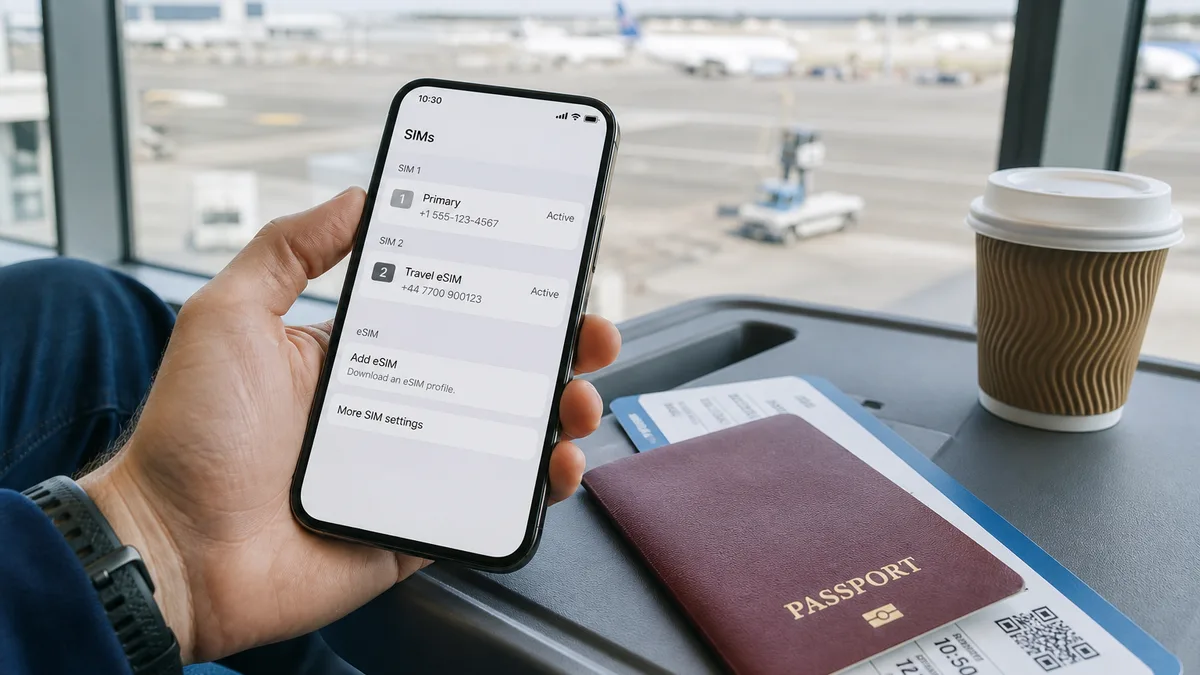
The setup that works: keep your UK SIM enabled for calls and texts but switch its mobile data off (and data roaming off, so nothing leaks), install the travel eSIM, and set it as the data line. Your UK number stays reachable, banking one-time codes arrive as SMS at no cost to receive in most destinations, and every byte of data flows through the eSIM at the price you chose in advance.
Two refinements: turn on Wi-Fi calling before you leave the UK — calls over hotel Wi-Fi through your UK number bypass roaming entirely on most networks — and download offline maps for your destination before you fly, which converts the single largest data drain into zero. If someone must call you at length while you are away, an internet-based call is free at both ends; the mobile network is the fallback, not the default.
Daily pass vs eSIM vs airport SIM: which wins where
Short EU city break with light use: your network's daily pass often wins on pure convenience — nothing to configure, number stays live, and one or two days' fees are a tolerable price for zero setup. Anything longer, multi-country trips, or destinations outside Europe flip the answer: a fixed-size eSIM bundle bought before travel is predictable, usually far cheaper for the data you actually use, and immune to bill shock.
Airport SIM and eSIM kiosks occupy a sensible middle: staffed help, instant activation, and regional bundles — useful if you want a human to set it up or discover on landing that your handset is locked. Whichever route you take, buy before you need it: configuring an eSIM over airport Wi-Fi with a queue for the kiosk is precisely the pressure-purchase situation this guide exists to remove.
The protections UK travellers get by default
Since October 2024, Ofcom rules require UK providers to send you a roaming notification when you start roaming, including pricing and fair-use information — so the "silent" bill shock of the early post-Brexit years is largely closed. Separately, a default monthly spend cap on mobile data used abroad applies unless you have actively opted out; it exists precisely to stop runaway data bills, and you can usually set a lower cap in your provider's app.
Know the failure mode that remains: inadvertent roaming near borders (including maritime and aircraft networks, which sit outside normal caps and passes on some plans) — if your phone shows an unfamiliar network name at sea or in the air, treat data as expensive until proven otherwise. When in doubt, airplane mode with Wi-Fi on costs nothing and keeps messages flowing.