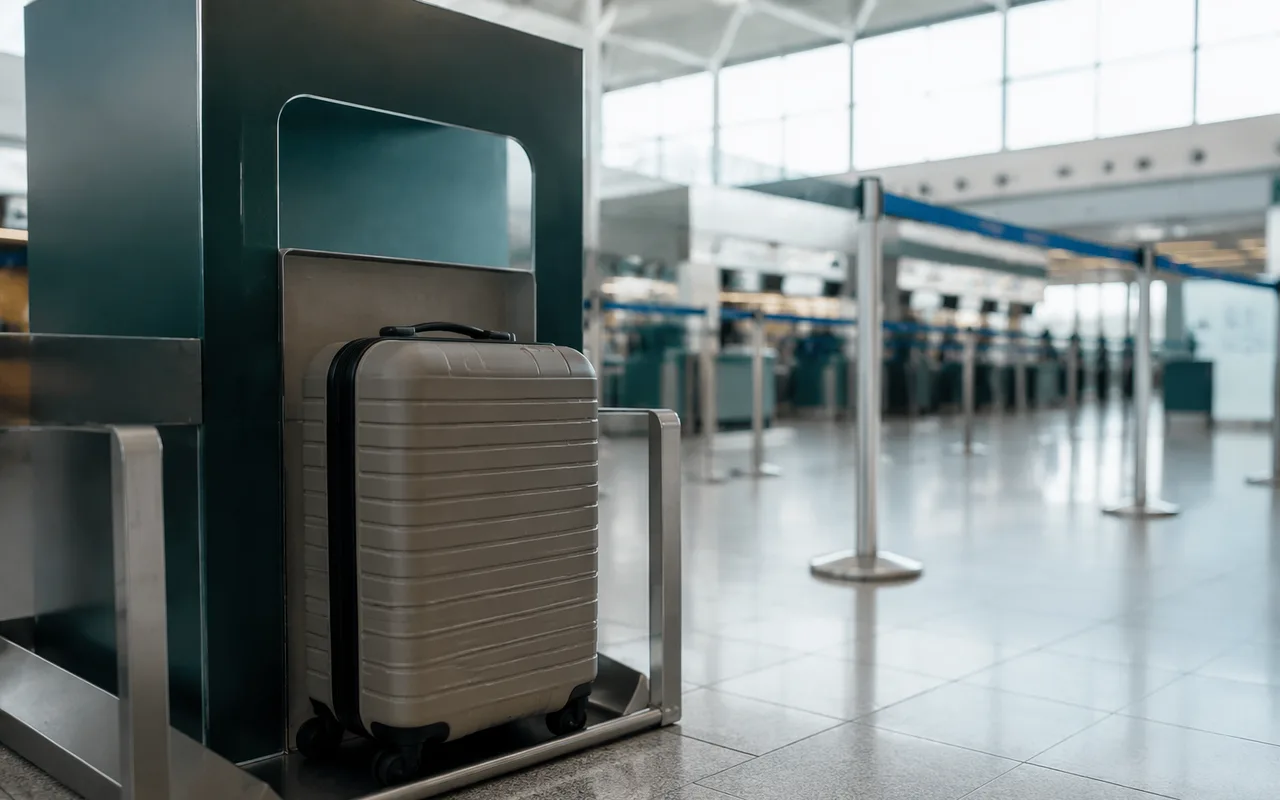
UK airline cabin bag sizes compared for 2026
The seven airlines UK travellers fly most publish meaningfully different free cabin allowances in 2026, and the gap between the most and least generous is roughly double the bag volume. British Airways: one cabin bag up to 56 × 45 × 25 cm and 23 kg, plus a smaller handbag or laptop bag up to 40 × 30 × 15 cm. easyJet: one free underseat bag up to 45 × 36 × 20 cm (15 kg stated maximum, though you must be able to lift it yourself); the larger 56 × 45 × 25 cm overhead case costs extra unless your seat includes it. Ryanair: one free small bag up to 40 × 20 × 25 cm that must fit under the seat; Priority & 2 Cabin Bags adds a 10 kg case up to 55 × 40 × 20 cm. Jet2: one cabin bag up to 56 × 45 × 25 cm and 10 kg, plus a small underseat item. Virgin Atlantic (Economy): one cabin bag up to 56 × 36 × 23 cm and 10 kg. TUI Airways: one cabin bag up to 55 × 40 × 20 cm and 10 kg. Wizz Air: one free underseat bag up to 40 × 30 × 20 cm and 10 kg, with a larger 55 × 40 × 23 cm trolley bag bundled with Wizz Priority.
Two patterns matter more than the raw numbers. First, full-service carriers (BA, Virgin, Jet2, TUI) include an overhead-locker case in every fare, while the low-cost carriers (Ryanair, easyJet, Wizz Air) include only an underseat bag and charge for the locker. Second, dimensions include wheels and handles at every airline — a case marketed as "cabin size" by a luggage brand can still fail a Ryanair or easyJet sizer if its wheels push it past the limit. Always confirm the current allowance on your airline's own baggage page before flying, because bundles and seat-linked allowances change during the year. For a side-by-side check of your exact bag against 28 airlines, use the tool at /tools/carry-on-checker.
Underseat bag vs overhead cabin bag: the distinction that decides your fare
The single most important cabin-bag concept at UK low-cost airlines is the split between a free underseat bag and a paid overhead cabin bag — they are priced, sized, and enforced as two different products. The underseat bag (Ryanair 40 × 20 × 25 cm, easyJet 45 × 36 × 20 cm, Wizz Air 40 × 30 × 20 cm) must slide fully under the seat in front of you, which in practice means a backpack, holdall, or small wheelie under about 20 litres. The overhead cabin bag (typically 55 × 40 × 20 cm, around a 38–40 litre trolley case) is what most people picture as "hand luggage", and on the low-cost carriers it is an add-on that can cost more than the seat itself on peak dates.
The practical consequence: a "carry-on only" trip on Ryanair with just the free allowance is a minimalist weekend, not a week away. If you are comparing fares across airlines, compare like for like — a Ryanair base fare plus Priority is the honest comparison against an easyJet fare with a large cabin bag added, and both against a Jet2 or BA fare where the overhead case is already included. Our airline baggage fees breakdown at /airlines/baggage-fees/ tracks what the paid tiers cost carrier by carrier.
Weight limits: who weighs cabin bags and when
UK airlines split into two camps on cabin bag weight: those with a published limit they actively enforce, and those where the limit is generous enough to be theoretical. British Airways publishes 23 kg for the main cabin bag — effectively "lift it into the locker unaided" — while easyJet states 15 kg for its free underseat bag. Jet2, Virgin Atlantic Economy, TUI, and Wizz Air all sit at 10 kg, and 10 kg is also the cap on Ryanair's paid Priority cabin case. Ryanair's free small bag has no published weight limit, but it must fit the sizer.
Enforcement concentrates where you would expect: gate agents at low-cost carriers spot-check heavy-looking bags on busy flights, and an overweight or oversized bag at the gate is charged at the most expensive rate in the fee table — typically well above what the same bag would have cost booked online in advance. Weigh your packed bag at home on bathroom scales, and keep heavy dense items (laptop, chargers, toiletries) in the underseat bag where the weight rules are more forgiving. Airline policies on weighing vary by airport and load, so treat the published limit as the rule, not the average enforcement.
How to measure your bag so the sizer agrees with you
Measure your bag the way the airport sizer does: height × width × depth including wheels, handles, side pockets, and anything strapped to the outside. Stand the case upright on a hard floor, measure floor-to-top including the wheel housings and the retracted handle, then measure the widest point across the front and the deepest point front-to-back with the bag packed — soft bags bulge, and a bulging front pocket is the most common reason a "compliant" bag fails a sizer at the gate.
Airport sizers are rigid frames, and the test is whether the bag slides in under its own weight without force. If your bag is within 1 cm of a limit on any axis, assume it will fail when fully packed and either repack into the compression zone or choose a smaller bag. Backpacks get the same treatment at strict gates — a 45-litre hiking pack does not become an underseat bag because it is soft. When in doubt, run the dimensions through /tools/carry-on-checker, which flags both the free allowance and the paid cabin-bag tier for your airline.
The 100ml liquids rule and the new UK airport scanners
The 100ml liquids rule still applies at most UK airports in 2026, but the rollout of next-generation CT security scanners is changing it airport by airport — so the correct answer depends on which airport you depart from. At airports where the new scanners are fully operational, the UK government has allowed airports to lift the limit to two litres per container and drop the requirement to remove liquids and laptops from bags. At airports still on older equipment, the classic rules apply: containers of 100ml or less, in a single clear resealable bag of roughly one litre, removed at security.
The trap for UK travellers is asymmetry: you might depart from a scanner-equipped airport with two-litre freedom and fly home from an overseas airport still enforcing 100ml. Pack for the strictest airport on your itinerary, keep the clear-bag habit for return legs, and check your departure airport's own security page in the week before travel — airports publish their current liquid rules as the scanner programme progresses. Our quick answer on the 100ml rule at /travel-answers/#liquids-100ml-rule covers the baseline, and the hand luggage overview at /travel-answers/#hand-luggage-sizes summarises the size question in one paragraph.
If your bag is too big: what actually happens at the gate
An oversized cabin bag at a UK gate is normally gate-checked into the hold for a fee that is the highest price in that airline's baggage table — low-cost carriers price gate bags punitively precisely because the fee is avoidable. The bag goes into the aircraft hold, you collect it at baggage reclaim at the other end, and anything fragile or valuable inside travels uninsured against rough handling. Full-service carriers are more likely to gate-check a compliant-weight bag for free when the flight is full and lockers run out, which is a different (and free) situation — keep medication, documents, and electronics in a small personal item for exactly this scenario.
The cheapest fix is always the one made before the airport: measure, weigh, and if the bag fails, add the larger cabin bag or hold luggage online, where the same allowance costs a fraction of the gate price. Compare the paid tiers across carriers at /airlines/baggage-fees/ before you assume buying up is expensive — on some routes the bundled fare with a cabin case included beats the base fare plus add-ons.